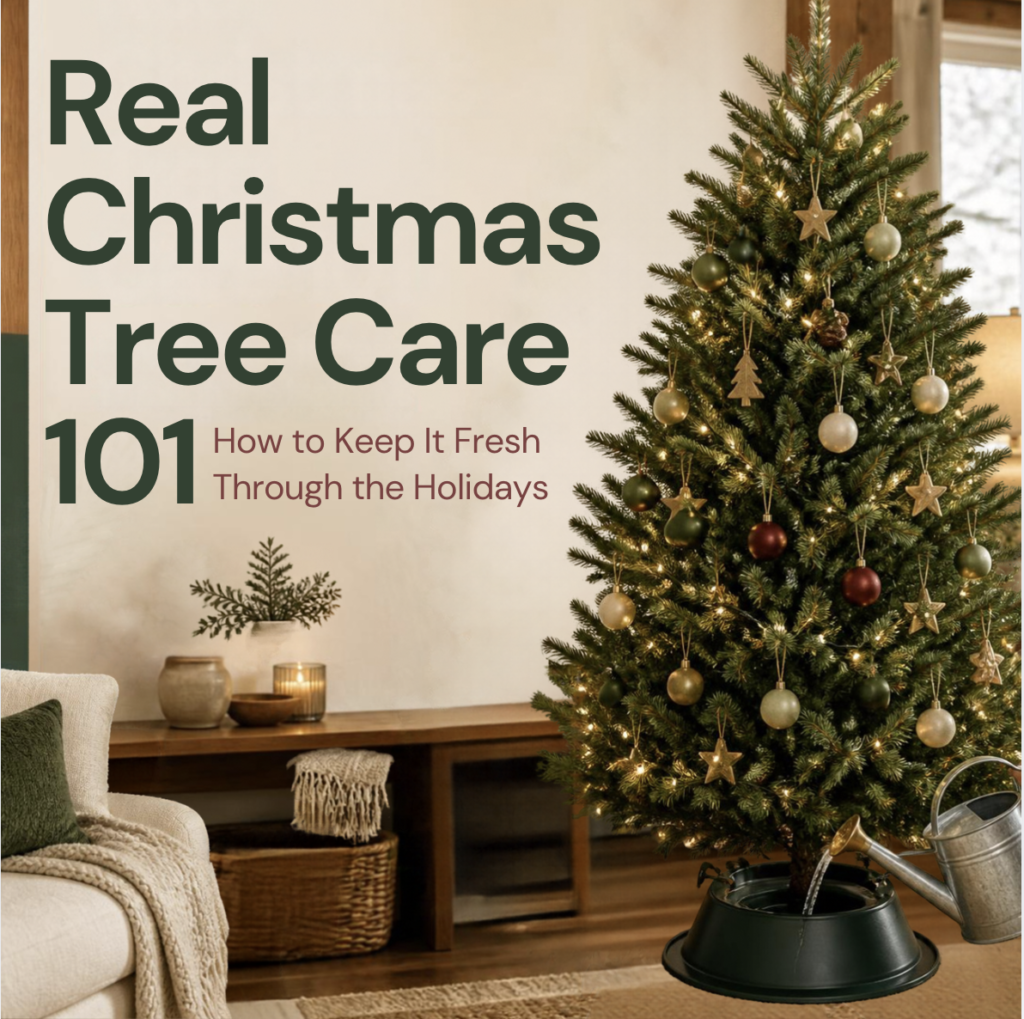
Live Christmas Tree Care 101: How to Keep It Thriving Through the Holidays
There’s nothing quite like a real Christmas tree. The smell of fresh pine or fir, the texture of real branches, and the tradition of picking out the perfect tree can make bringing it home feel like the official beginning of the holiday season.
The downside? A cut Christmas tree starts losing moisture as soon as it is harvested. By the time Christmas arrives, a tree that looked full, green, and beautiful at the beginning of December can become dry, brittle, and surrounded by fallen needles.
The good news is that you have more control over that process than you might think.
Keeping a real Christmas tree fresh throughout the holiday season comes down primarily to starting with a fresh tree, helping it take up plenty of water, protecting it from excessive heat, and paying attention to the signs that it’s beginning to dry out.
Here’s how to help your real Christmas tree stay beautiful from tree-shopping day through Christmas—and hopefully well beyond.
Start With the Freshest Christmas Tree You Can Find
How long your Christmas tree lasts inside your home begins before you ever put it in the stand.
When you’re shopping for a cut tree, look for one with vibrant color and flexible needles. Run your hand gently along a branch or give the tree a light shake. A few loose interior needles aren’t necessarily concerning, but you don’t want handfuls of green needles falling off.
You can also gently bend a few needles. Fresh needles should generally have some flexibility rather than immediately snapping.
If you’re buying from a Christmas tree lot, don’t be afraid to ask when the trees arrived or how they have been stored. Trees protected from excessive sun and drying wind may retain moisture better than trees that have spent an extended period exposed to harsh conditions.
And, of course, cutting your own tree from a Christmas tree farm gives you a major advantage: you know exactly how recently it was cut.
Give the Trunk a Fresh Cut
Before putting your Christmas tree into its stand, make a fresh, straight cut across the bottom of the trunk.
Why?
After a tree is cut, the exposed surface can begin drying and sealing with resin. A fresh cut helps expose tissue that can take up water once the tree is placed in its stand.
Ideally, make the cut shortly before putting the tree into water.
Avoid carving the trunk into a point or shaving down the sides simply to force an oversized trunk into a smaller stand. The outer layers of the trunk are important for water uptake.
Instead, choose a tree stand that’s appropriately sized for the trunk of your tree.
Get Your Tree Into Water Quickly
Once you’ve made a fresh cut, don’t leave the tree sitting around for hours while you rearrange the living room, untangle the lights, and search the garage for the tree stand.
Get it into water.
A freshly cut Christmas tree can take up a surprising amount of water, particularly during the first several days indoors.
If you aren’t ready to decorate immediately, that’s okay. Put the tree in its stand with water first. The ornaments can wait.
Hydration can’t.
Check the Christmas Tree Stand Every Single Day
This is probably the single most important thing you can do to help a real Christmas tree last longer.
Check the water every day.
Don’t assume there’s enough water because you filled the stand yesterday. Large, fresh trees can use significant amounts of water, particularly during their first days indoors.
Make checking the tree part of your daily December routine. Coffee, breakfast, check the Christmas tree.
Most importantly, don’t allow the water level to drop below the cut end of the trunk. If that happens, the exposed trunk can begin drying, potentially making it harder for the tree to continue taking up water effectively.
A large-capacity stand makes this job considerably easier because you won’t need to refill it as frequently.
Plain Water Does Most of the Heavy Lifting
There are countless Christmas tree hacks floating around: sugar, soda, aspirin, bleach, corn syrup, pennies, vodka, and all sorts of homemade concoctions.
You don’t need to turn your Christmas tree stand into a chemistry experiment.
The most important thing your tree needs is consistent access to water.
That doesn’t mean there aren’t products designed to help with water management, but no additive can compensate for a tree stand that has gone dry.
Before worrying about what you’re putting in the water, make sure you’re providing enough water in the first place.
Where Does That Yucca Stuff Fit In?
That Yucca Stuff™ is made with Yucca schidigera and functions as a natural surfactant, helping water spread and penetrate more effectively.
Yucca-derived saponins are valued for their surfactant properties, which is why yucca is used in soil and plant-care applications involving water movement.
For your normal plants, this can help water spread more evenly through growing media rather than channeling through dry or difficult-to-wet areas.
A cut Christmas tree is different because there is no soil or root system involved. Your tree is taking water directly through the cut trunk.
If you choose to incorporate That Yucca Stuff into your holiday plant-care routine, follow the product’s current label directions and remember the most important rule for the Christmas tree itself: never let the stand run out of water.
That Yucca Stuff can also continue being useful for all those houseplants that suddenly have to relocate because a seven-foot Christmas tree just stole their favorite window.
Find That Yucca Stuff™ HERE or on Amazon
Keep Your Christmas Tree Away From Heat
Where you put your Christmas tree can have a major impact on how quickly it dries.
Fireplaces may create a beautiful Christmas-card scene, but placing a real tree directly beside one isn’t ideal. The same goes for wood stoves, radiators, baseboard heaters, heating vents, and portable space heaters.
Heat increases moisture loss.
If possible, position your tree away from major heat sources and avoid having a heating vent blow directly onto the branches.
You don’t have to keep your living room freezing cold for the sake of the Christmas tree. Simply avoiding concentrated heat can help reduce unnecessary drying.
Consider Turning Down the Temperature
Your Christmas tree has another reason to appreciate a slightly cooler house.
Warmer indoor temperatures can contribute to faster moisture loss. If you’re comfortable lowering your thermostat a little—particularly overnight or when you’re away from home—it may also create a friendlier environment for your tree.
This doesn’t mean your family needs to spend December wearing coats indoors.
Even small changes, combined with keeping the tree away from direct heat sources, can help.
Use LED Christmas Lights
If you haven’t already switched to LED Christmas lights, your real tree gives you another good reason to consider it.
LED lights generally produce much less heat than traditional incandescent Christmas lights. That means you’re adding less heat directly against your tree’s needles and branches.
There’s also an energy-use advantage, especially for households that like to keep their tree glowing for hours every evening.
Whichever lights you use, inspect the strands before putting them on the tree. Replace damaged lights, frayed wires, or questionable electrical decorations rather than taking a chance.
Don’t Leave the Lights On Constantly
Your Christmas tree doesn’t need to be illuminated 24 hours a day.
Turn the lights off when you go to bed and when you’re leaving the house for an extended period. A simple outlet timer or smart plug can make this easy—you don’t even have to remember.
You could set the tree to turn on automatically in the late afternoon and shut off around bedtime.
Besides reducing unnecessary electricity use, this also limits the amount of time your tree is exposed to whatever heat your lights generate.
Think About Humidity, Too
Winter air can be extremely dry, particularly once your home’s heating system is running regularly.
Low indoor humidity contributes to the overall drying environment surrounding your Christmas tree.
If your home is especially dry, running a humidifier in the room can make the environment a little less harsh. It may also make the room more comfortable for the humans living there.
Just don’t directly spray or soak your decorated tree, particularly once electrical lights are installed. Your primary hydration strategy should remain the water reservoir in the stand.
Be Careful With Sunny Windows
A Christmas tree framed by a big window can look gorgeous from both inside and outside the house.
But pay attention to how much direct sunlight comes through that window.
A sunny south- or west-facing window can warm the tree considerably during the day, even when outdoor temperatures are cold. If you notice strong afternoon sun hitting the tree for hours, closing blinds or curtains during the brightest portion of the day can help reduce that extra heat.
Indirect natural light isn’t the problem. You’re simply trying to avoid creating an unexpectedly warm spot around the tree.
Watch What Your Tree Is Telling You
Your Christmas tree will usually give you clues that it’s drying out.
Needles may begin dropping more frequently. Branches may become less flexible. The tree’s color can begin fading. Needles that once bent may become brittle and snap easily.
Some needle loss is normal. Evergreen trees naturally retain older interior needles that may fall once the tree is moved and handled.
What you want to watch for is a significant change in the tree’s condition.
If you’re suddenly sweeping up large quantities of needles every day and the branches feel increasingly dry and brittle, your tree may be reaching the end of its safe indoor lifespan.
What If Your Christmas Tree Stops Drinking Water?
First, make sure the water level hasn’t accidentally fallen below the bottom of the trunk.
If your tree previously consumed a lot of water and suddenly seems to stop, continue monitoring both the water level and the physical condition of the tree.
A decrease in water consumption later in the season doesn’t automatically mean something is wrong. However, if it happens alongside significant needle loss, brittle branches, discoloration, or obvious drying, pay closer attention.
Don’t assume adding more ingredients to the water will revive a severely dried-out tree.
At that point, safety becomes more important than squeezing another week out of your decorations.
Don’t Forget About Fire Safety
A fresh, well-hydrated Christmas tree and a severely dried Christmas tree are very different things.
Keeping the stand full isn’t just about preventing a carpet covered in needles. Hydration is an important part of maintaining a safer real Christmas tree.
Keep open flames—including candles—away from the tree. Check electrical decorations for damage. Don’t overload outlets or extension cords. Keep the tree away from fireplaces and heaters.
And make sure your home has working smoke alarms.
The goal isn’t to be afraid of having a real Christmas tree. It’s to enjoy one responsibly.
Make Watering Easier on Yourself
One of the biggest Christmas tree problems isn’t knowing that the tree needs water.
It’s actually getting under all those branches to fill the stand.
Once you’ve wrapped presents around the base of the tree, crawling underneath with a pitcher of water becomes even less appealing.
Make the job easier from the beginning. Choose a stand with a large reservoir and an opening that’s reasonably easy to access.
You can also keep a dedicated watering pitcher nearby or use a Christmas tree watering funnel or tube that allows you to refill the reservoir without crawling beneath the branches.
The easier you make the task, the more likely someone in your household is to actually do it every day.
Don’t Block the Stand With Presents
It looks beautiful when Christmas morning approaches and presents completely surround the tree.
It becomes less beautiful when you realize you’ve built a wall between yourself and the water reservoir.
Leave yourself an access point.
If necessary, arrange presents so you can easily move one or two packages rather than dismantling half of Santa’s workshop every time the tree needs water.
It’s a small planning decision that can make daily tree care considerably less annoying.
What About Pets?
Christmas trees are fascinating to many pets.
Unfortunately, Christmas tree stands can be fascinating, too.
If you have a dog or cat that likes drinking from unusual water sources, consider how you’ll prevent them from treating the Christmas tree stand as their personal holiday water bowl.
A tree skirt or stand cover may help limit access, depending on your setup and the determination level of your pet.
You’ll also want to secure the tree if you have pets—or young children—who might pull, climb, bump, or otherwise investigate it a little too enthusiastically.
Keeping the tree upright is an underrated part of Christmas tree care.
How Long Should a Real Christmas Tree Last?
There’s no universal expiration date.
How long your tree stays fresh depends on the species, how recently it was harvested, its condition when you purchased it, how quickly you got it into water, how consistently you’ve kept the reservoir filled, and the conditions inside your home.
That’s why choosing a fresh tree and caring for it correctly from day one matters so much.
A tree that has already spent weeks drying out before you purchase it has a very different starting point from one that was recently harvested.
Instead of relying entirely on the calendar, monitor the actual condition of your tree.
When Is It Time to Take the Christmas Tree Down?
We understand.
You’re not ready.
The ornaments look perfect, the lights make the living room cozy, and taking down the tree officially means admitting the holidays are over.
But eventually, the tree gets the final vote.
If it becomes very dry, brittle, discolored, or begins dropping excessive amounts of needles, it’s time to remove it—even if you’d prefer to keep Christmas going a little longer.
A dried-out tree isn’t going to become fresh again because you’re emotionally committed to leaving it up until January 15.
Take the decorations down, remove the lights, and check your local Christmas tree recycling options.
Give Your Christmas Tree a Second Life
Taking down your tree doesn’t necessarily mean its usefulness is over.
Many communities offer Christmas tree recycling or chipping programs after the holidays. Trees may be turned into mulch, composted, or used for other community or conservation purposes.
Depending on where you live and local regulations, you may also have options for repurposing parts of your tree at home.
Branches can sometimes be used as winter protection over garden beds or incorporated into appropriate outdoor projects. If you’re considering putting the tree into a compost pile or using it elsewhere in the landscape, remember that woody material breaks down much more slowly than typical green compost materials.
Check your local recycling options before putting the tree at the curb. Your Christmas tree may still have another job to do.
A Little Daily Care Can Keep Christmas Going Longer
You don’t need an elaborate Christmas tree maintenance routine.
Most of the work comes down to a handful of simple habits:
Start with the freshest tree possible. Make a fresh cut. Get it into water quickly. Check the reservoir every day. Keep it away from heat. Use lower-heat lights. Pay attention to the needles and branches.
And most importantly, don’t wait until the tree looks dry to start thinking about hydration.
Your Christmas tree has already been separated from its roots. From that point forward, you’re working to help it retain as much moisture as possible.
Give it plenty of water, keep it cool, and pay attention to what the tree is telling you.
Hopefully, you’ll still have a beautiful, fragrant, needle-holding tree when everyone gathers around it on Christmas morning.