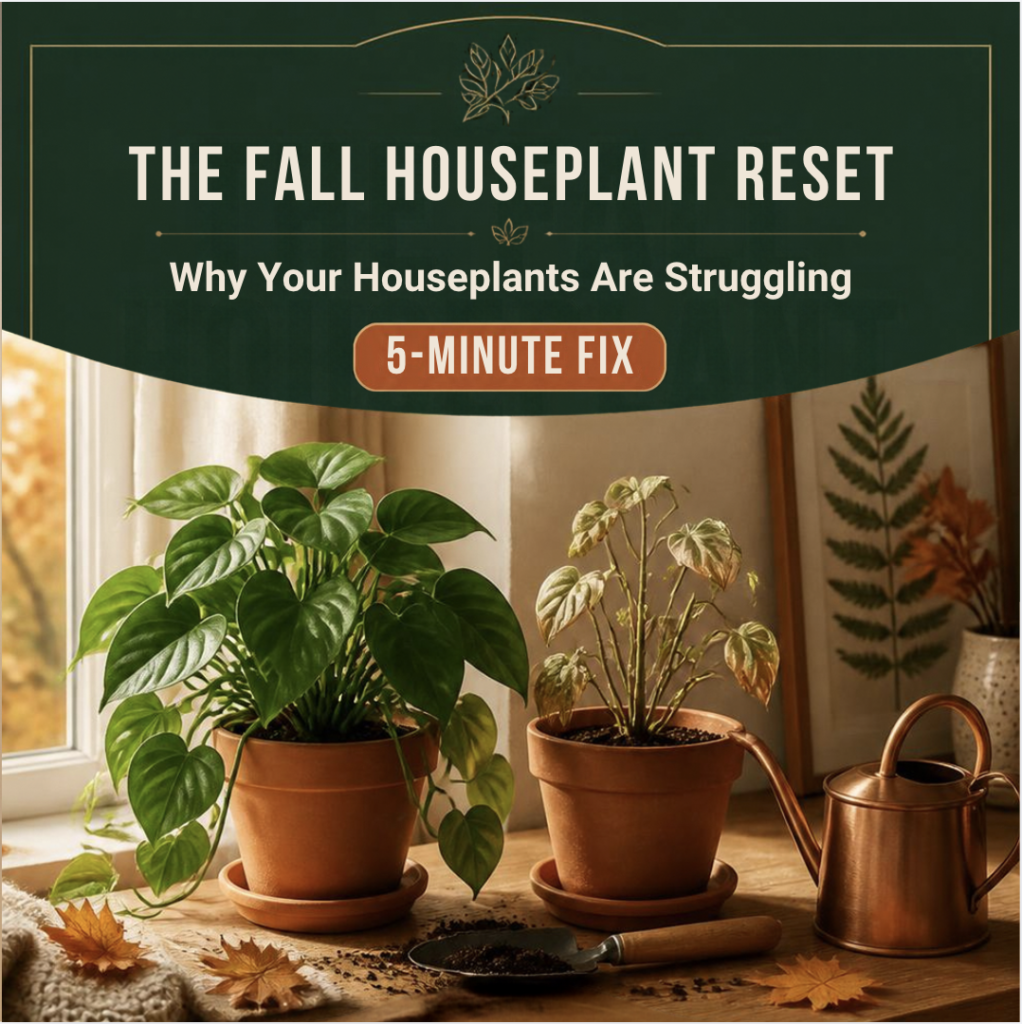
The Fall Reset: Why Your Houseplants Are Struggling (And How to Fix It in 5 Minutes)
Fall can be a strange time for houseplants. The plants that seemed perfectly happy all summer suddenly start looking a little less enthusiastic about life. Leaves turn yellow. Growth slows down. Soil seems to stay wet forever—or somehow becomes so dry and compacted that water runs straight down the sides of the pot. A plant that was putting out new leaves every few weeks may suddenly stop growing altogether.
Before you assume your houseplant needs fertilizer, a bigger pot, or an emergency intervention, there is something important to remember: your plant’s environment just changed.
Even though your houseplants live indoors, they still experience the changing seasons. Shorter days, weaker sunlight, cooler temperatures, indoor heating, lower humidity, and changes in watering habits can all affect how plants use water and nutrients.
That makes early fall a great time for a simple houseplant reset—and you can give most plants a quick checkup in about five minutes.
Why Houseplants Change in the Fall
During spring and summer, many houseplants enter their most active growing period. Longer days and stronger sunlight provide more energy for photosynthesis, which often means faster growth and greater water use.
Then fall arrives.
Daylight hours gradually decrease, the angle of the sun changes, and the amount of usable light reaching your plants may drop significantly. A plant sitting near a bright window in July may receive considerably less light in October, even though you haven’t moved it.
Less light usually means slower growth.
And slower growth often means your plant doesn’t need water as frequently as it did during summer.
This is where many fall houseplant problems begin.
If you continue watering according to your summer schedule, the soil may remain wet much longer. Constantly saturated soil can reduce the amount of oxygen available around the roots and contribute to root problems.
At the same time, turning on your home’s heating system can create the opposite problem above the soil. Indoor air may become significantly drier, particularly around heating vents.
Your houseplant can suddenly find itself dealing with wet roots and dry air at the same time.
No wonder it looks confused.
The 5-Minute Fall Houseplant Reset
You don’t necessarily need to completely repot your plants or overhaul your indoor garden. Start with five minutes and check five things.
Minute 1: Check the Soil Before You Water
One of the easiest fall mistakes is watering based on the calendar instead of the plant.
If you watered every seven days during summer, it can become automatic to continue doing exactly that. But your plant’s water use may have changed.
Stick your finger about an inch or two into the soil. If the soil still feels damp, your plant probably doesn’t need another drink yet.
For larger pots, checking only the surface can be misleading. The top inch of soil may feel dry while the lower portion of the pot is still holding substantial moisture. A wooden chopstick or inexpensive moisture meter can help you get a better idea of what’s happening deeper in the container.
The goal isn’t to establish another rigid watering schedule.
Instead, check the soil and let the plant tell you when it needs water.
Depending on the plant, pot size, soil, temperature, humidity, and available light, a houseplant that needed water every week during summer might suddenly go considerably longer between waterings in fall and winter.
Minute 2: Look at How the Soil Is Absorbing Water
When you do water, pay attention to what happens.
Does water soak evenly into the soil?
Or does it immediately run down the sides of the pot and out through the drainage holes?
Potting soil can become hydrophobic when it dries excessively, meaning it becomes difficult to rewet. Instead of soaking into the root zone, water may follow cracks and gaps through the container.
This can create a frustrating situation where you’re technically watering the plant, but portions of its root system aren’t actually receiving much moisture.
Other signs of soil problems include:
- Water pooling on top of the soil before slowly soaking in
- Soil pulling away from the edges of the container
- Hard or compacted soil
- Extremely uneven drying
- Water immediately pouring through the bottom of the pot
- Some areas of the soil remaining bone dry after watering
If you’re seeing these problems, your plant may not necessarily need more water. It may need help getting the water you’re already providing distributed throughout the soil.
Minute 3: Give Your Plant a Light Check
Take a few seconds to look at where your plant is sitting.
The location that provided plenty of light during summer may not provide the same conditions in fall.
Watch how sunlight moves through your home throughout the day. You may find that moving a plant a few feet closer to a window makes a noticeable difference.
But don’t assume every plant should suddenly sit directly against the brightest window in your house. Plants have different light requirements, and a dramatic change can sometimes cause stress.
Instead, make gradual adjustments.
You should also clean dusty leaves while you’re checking your plants. Dust can accumulate surprisingly quickly on large-leaf houseplants. Gently wiping leaves with a damp cloth keeps them clean and gives you an opportunity to inspect the plant closely.
While you’re there, check the undersides of leaves and stems for signs of pests such as spider mites, scale, mealybugs, or fungus gnats.
Catching a pest problem when it involves one plant is much easier than discovering it after it has spread across your entire collection.
Minute 4: Check Temperature and Humidity
Your house may feel comfortable to you while creating a challenging little microclimate for your plants.
Look around your plant.
Is it sitting directly above a heating vent?
Next to a drafty window?
Near an exterior door that frequently opens?
Beside a fireplace?
Plants sitting near heating vents can experience warm, extremely dry air. Plants pressed against cold windows may experience dramatic temperature changes overnight.
Moving the plant even a few feet can sometimes improve its environment.
Humidity-loving plants may also benefit from being grouped together or placed near a humidifier during particularly dry months.
One thing that probably won’t solve a genuinely dry indoor environment is occasionally misting the leaves. Misting can temporarily wet the leaf surface, but it usually doesn’t significantly change the room’s overall humidity.
If humidity is truly the problem, addressing the surrounding environment is more effective.
Minute 5: Help Water Work More Efficiently
This is where That Yucca Stuff™ can become part of your fall houseplant routine.
Yucca contains naturally occurring compounds called saponins, which can act as wetting agents. A wetting agent helps water spread through growing media rather than simply beading up or finding the quickest path through dry soil.
That can be especially helpful when container soil has become difficult to rewet or water isn’t distributing evenly through the pot.
Think of it less as “feeding” the plant and more as helping improve the relationship between water and soil.
For houseplants, follow the current That Yucca Stuff label directions for mixing and application. Water the soil thoroughly and allow excess water to drain freely from the bottom of the container.
And remember: better water distribution doesn’t mean the plant should be watered more frequently. You should still allow the soil to dry according to the needs of that particular plant.
Don’t Automatically Reach for Fertilizer
When a houseplant stops growing, one of our first instincts can be to feed it.
More fertilizer must equal more growth, right?
Not necessarily.
If your plant has slowed down because it is receiving less light, adding fertilizer doesn’t fix the underlying problem. Depending on the plant and growing conditions, you may need to reduce fertilizer applications during fall and winter.
This is another reason a fall reset is useful.
Before adding anything, ask:
Is this plant actually hungry, or has its environment changed?
Check light, water, soil condition, temperature, drainage, and pests first.
If those conditions are good and the plant is actively growing, you can determine whether feeding is appropriate for that particular species.
Should You Repot Houseplants in the Fall?
You can repot many houseplants during fall, but that doesn’t mean every plant needs it.
If the plant is healthy and its potting mix is still functioning properly, there’s usually no reason to repot simply because the season changed.
Repotting may make sense if you notice:
- Roots heavily circling inside the container
- Roots growing extensively through drainage holes
- Severely compacted or degraded potting mix
- Soil that no longer drains properly
- A damaged container
- Root problems that require intervention
- A plant that has clearly outgrown its current pot
If you do repot, resist the temptation to move a small plant into a dramatically larger container. Excess soil around a relatively small root system can remain wet longer than expected.
Moving up one reasonable container size is often enough.
Yellow Leaves Don’t Always Mean Disaster
Few things make a plant owner panic faster than a yellow leaf.
But one yellow leaf doesn’t necessarily mean your plant is dying.
Older leaves naturally age and drop. Plants can also respond to environmental changes by shedding leaves.
What matters is the pattern.
One older leaf gradually turning yellow may be normal.
Multiple leaves suddenly yellowing deserves investigation.
Check the soil first. If it has remained wet for a long period, excessive moisture could be contributing to the problem. Then check light levels, temperature changes, drainage, roots, and pests.
Instead of treating the yellow leaf as the problem, treat it as information.
Your plant is giving you a clue.
The Biggest Fall Houseplant Mistake: Loving Them Too Much
When plants stop growing, we tend to start doing things.
More water.
More fertilizer.
A new pot.
A different window.
Another watering because the leaves looked sad.
Then another relocation because maybe the first window wasn’t right.
Sometimes the best thing you can do for a houseplant is less.
Plants naturally respond to seasonal changes. Slower winter growth isn’t automatically a sign that something is wrong.
Your job isn’t necessarily to keep every houseplant growing at its July pace throughout December.
Your job is to give the plant the conditions it needs to remain healthy.
Your Fall Houseplant Checklist
Before you walk away from your plant, ask yourself:
- Is the soil actually dry enough to need water?
- Does water absorb evenly throughout the pot?
- Is the plant receiving enough light?
- Has the seasonal sunlight changed?
- Is the plant sitting near a heating vent or cold draft?
- Are the leaves dusty?
- Are there signs of pests?
- Does the container have adequate drainage?
- Does the plant truly need fertilizer?
- Is the plant rootbound, or am I repotting simply because growth slowed?
You don’t have to solve every possible problem today.
A five-minute inspection can tell you a surprising amount.
Give Your Houseplants a Fall Reset
Fall doesn’t have to mean watching your houseplant collection slowly become sadder as winter approaches.
It simply means adjusting your care routine to match a different season.
Check the soil before watering. Pay attention to how water moves through the pot. Give your plants the light they need. Protect them from extreme temperature changes. Watch your indoor humidity. Clean their leaves. Look for pests.
And when container soil becomes difficult to wet evenly, That Yucca Stuff™ can help water spread more effectively through the growing media so moisture can reach the root zone instead of simply running past it.
Find That Yucca Stuff™ HERE or on Amazon
Five minutes isn’t much.
But sometimes five intentional minutes are exactly what your houseplants need before heading into winter.